Water and carbon dioxide have no bond directly joining two oxygen atoms. Hydrogen peroxide has an O–O single bond. How could that bond form on ice in space?
A team including researchers at Berkeley Lab investigated pathways to O–O-containing products by shining vacuum ultraviolet light on small clusters of water and CO₂ molecules. The work offers a molecular explanation to investigate for peroxide chemistry on icy moons. Berkeley Lab research highlight
This article follows the research and lets you switch between molecules to find O–O bonds. Structure drawing and bond matching use chematic 1.1.7.
Nearby water molecules help direct the reaction
The team made CO₂–water clusters in a molecular beam, ionized them with vacuum ultraviolet light, and analyzed the product ions by mass spectrometry. Water-rich clusters favored peroxide-forming chemistry. Changes caused by a small number of surrounding solvent molecules are called microsolvation effects. Original paper abstract
One observed product had a mass-to-charge ratio, m/z, of 78. The team assigned it to [H₂CO₄]⁺, consistent with O–O bond formation. A signal at m/z 112, assigned to a cluster containing H₂O₂, also supports a pathway to hydrogen peroxide.
Carbon dioxide and hydrogen peroxide connect oxygen differently
CO₂ is O=C=O: carbon sits between its two oxygen atoms. Hydrogen peroxide is H–O–O–H. The oxygen count is the same, but the connections differ.
SMARTS describes structural patterns to search for. The pattern [#8]-[#8] asks for two atoms of atomic number 8 joined by a single bond. The viewer marks matching oxygen atoms with blue circles. Its examples are neutral water, CO₂, hydrogen peroxide and carbonic acid molecules.
Switch molecules and find the O–O bond
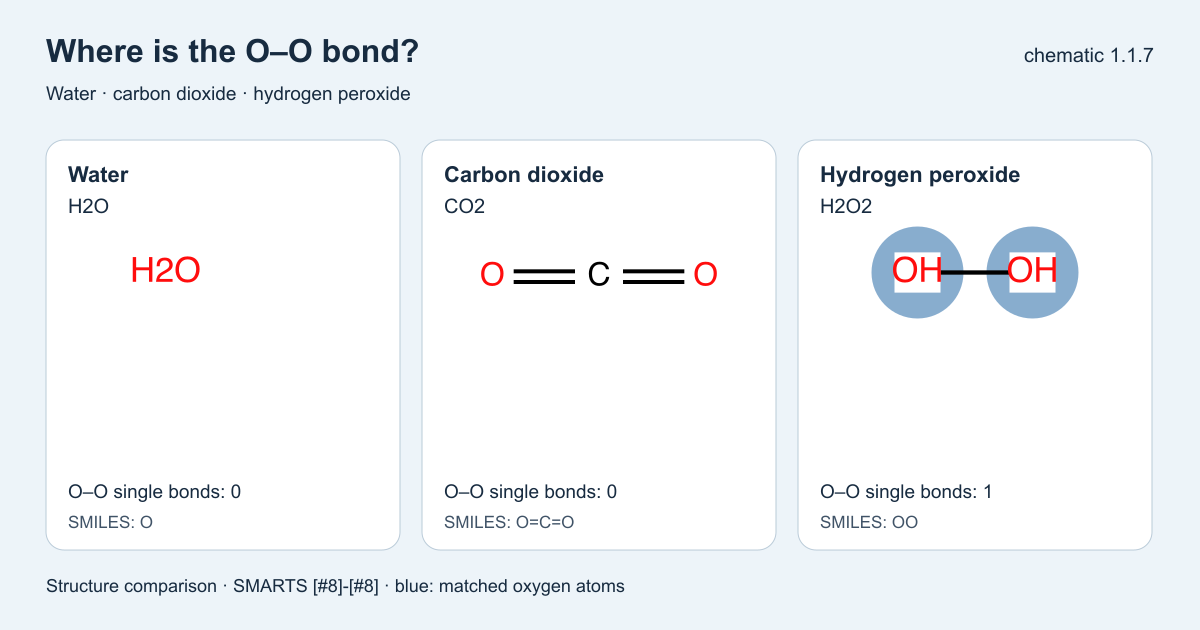
Switch from water to hydrogen peroxide: the O–O count changes from zero to one. Under “Try your own SMILES,” enter O=O for zero matches or OO.OO for two. The = specifies a double bond; the dot separates components with no bond between them. The search reflects those distinctions.
The energy slider calculates vacuum wavelength using E = hc/λ. Berkeley Lab reports an appearance energy of about 10.8 eV for the m/z 78 product, equivalent to about 114.8 nm. Increasing photon energy shortens the wavelength. The conversion uses SI constants published by NIST.
Run the same bond search in JavaScript
Save inspect.mjs, then run these commands with Node.js:
npm install @kent-tokyo/chematic@1.1.7
node inspect.mjs
The script matches [#8]-[#8] against each molecule and deduplicates atom pairs so each bond is counted once. Each output line contains the SMILES, molecular formula and O–O single-bond count:
O H2O 0
O=C=O CO2 0
OO H2O2 1
O=C(O)O CH2O3 0
Carbonic acid appears as CH2O3, with carbon first in the formula. The results JSON also records molar masses and the matched atom indices.
Apply this search to a compound list to extract molecules with O–O single bonds. Reading atom counts from a formula and checking connections with a structural query helps when organizing proposed products from a paper or choosing molecules for a lesson.
Dias and colleagues published “Ionization-Driven Oxygen–Oxygen Bond Formation in Mixed CO₂–H₂O Clusters” online in JACS on August 13, 2026. Berkeley Lab’s research highlight followed on October 14. The package used for the structure calculations and the sources are recorded in the execution record.